Friday, February 26, 2010

Market Review 2/26/10

Market was slightly up today due to better economic news. The CDS on Greece went down today to 364 bps, proving my argument that the spread between the CDS on Greece and VIX has to come down. See my earlier post. I argued that either the VIX has to go up or the CDS on Greece has to come down.

As I mentioned before the VIX futures term structure is very steep, and it actually steepened today. The short term volatilties collapsed since February 8. The March VIX futures closed at 20.35, while the April futures closed at 23.45. The difference of 3.1 points is significantly higher than historical medians. Around 90% of the time the spread is smaller than 3.1 points.
So I argue that the spread between the two has to come down. Either the Mar VIX has to go up or the April VIX has to come down.
How could you take advantage of the difference? You could go long Mar VIX and short Apr VIX or sell some ITM Mar VIX puts and some ITM Apr VIX calls.
Any other ideas?

Euro implied volatility smile

Today the WSJ had an article about several hedge funds betting on weaker Euro. The demand for puts shifted the implied volatility smile to the left:

Compare this to 5/31/09 smile:

Late last year the papers were all over Gold. The implied volatility smile was skewed to the right due to demand for Gold calls. GLD reached 119 on Dec 2. Today the GLD smile has a negative skew as well.

VIX and CDS on Greece

Over the past month Greece was in the news almost every day. It clearly had an impact on the U.S. market. Here is a chart comparing the CDS on Greece to the VIX:
Recently the CDS went up but VIX stayed around 20. Some investors are buying European stocks because they look at VIX and they think the Greek crisis is going to go away. Others are buying volatility, betting that the Greek crisis is not over.

Thursday, February 25, 2010

First Week

I'm really exited to see more than 1,000 visitors of my blog in the first week. What is more surprising is that fact that the visitors came from 38 countries. I would never guessed that someone from Paraguay, Malaysia or Latvia would be interested in VIX options.

I have to thank Bill Luby at Vixandmore again for his endorsement. I'm looking forward for his Expiring Monthly magazine which is the brainchild of five of the top options bloggers on the Internet: Adam Warner of the Daily Option Report, Bill Luby of VIX and More, Jared Woodard of Condor Options, Mark Wolfinger of Options for Rookies, Mark Sebastian of Option 911. I learned a lot from these guys over the years.

I find options on volatility a fascinating subject and I hope I will have the energy to write about interesting topics for long time.

Market Review 2/25/10

The S&P 500 sold off 1.5% this morning on Greek debt concerns and higher than expected jobless claims. The VIX spot jumped to 22.7% slightly higher than the March VIX futures.

On February 8 the costs of protecting against a government debt default by Greece was trading at 425 bps. At that point the VIX was 26.5, and the S&P 500 was around 1,050. Prospects that the EU would extend a financial lifeline to Greece sent Greek bonds to their biggest rally since the introduction of the euro.
While the VIX stayed around 20 over the past week the CDS on Greece went up from 350 bps to 400 bps today. As the market started to focus on this issue again, I wonder what would happen to the VIX and the S&P 500 if the CDS on Greece would reach new highs.

Maybe this is the reason the April VIX futures are still high, and actually rose today to 23.7. The spread between the VIX spot (20.1) and the April VIX futures is pretty wide at 3.6 points.

Wednesday, February 24, 2010

Market Update 2/24/10

The VIX term structure steepened as markets rebounded after Bernanke's speech.

Over the past 2 weeks VIX and VIX futures came down significantly. VIX call options lost value over this time period.
For example the 25 March VIX call options were trading at $3 on Feb 8. Today they closed at $0.6.
Here are the factors driving the price change:
-the March VIX futures went down from 26.2 to 21.7 today. This caused a loss of $2.3 in the price of the VIX call options
-options loose value over time, this option lost about $0.6 over this time period
-the option gained about $0.5 due to the increase in the implied volatility (from 73% to 88%). This is something unique to VIX options as I mentioned in my prior post, the IV goes up as they get closer to expiration. It is interesting how this reduces the cost of carry (theta) of these options.

If you add these up you get to the price difference of $2.4.

In case you were shorting this monster you are a happy guy.

Introduction to VIX options (Part 1)

First I want to mention that I’m honored to be included among Bill Luby’s (Vixandmore) favorite option blogs. Bill is one of the top option bloggers.

One of my goals with this blog is to explore the VIX options, which are one of the most complex instruments available for individual investors.

Volatility is certainly a fascinating subject. Imagine a formula for gauging human emotion – what could be more interesting than that?

Implied volatility of VIX options is the second derivative of the price of the S&P 500. Unless you like math, it gives you a headache just thinking about it.

Even CBOE admits “calculating exact theoretical values for VIX options can be very complex”.

Why is so complex?

First reason:
CBOE decided to base the price of VIX options not on the current level of the VIX, but on the anticipated level of the VIX at expiration. The price of any index option depends on the forward price of the index and the expected shape of the forward price distribution. Forward prices of option volatility exhibit a "term structure", meaning that the prices of options expiring on different dates may imply different volatility estimates.
VIX options investors look at the prices of the VIX futures to gain a better general idea of how the market is estimating the forward value of VIX.
As I mentioned before on average the VIX term structure is upward sloping, probably due to investor demand for volatility hedging.
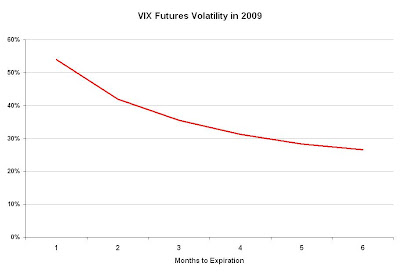
Historically, VIX futures have tended to be less volatile, on average, than the VIX index itself. The volatility is lower for longer dated futures.
This means that as they get closer to expiration the VIX options implied volatility is increasing.
In option language this means that if you hold a VIX option you lose money due to theta but you make money due to higher implied volatility as you get closer to expiration.

To be continued….